
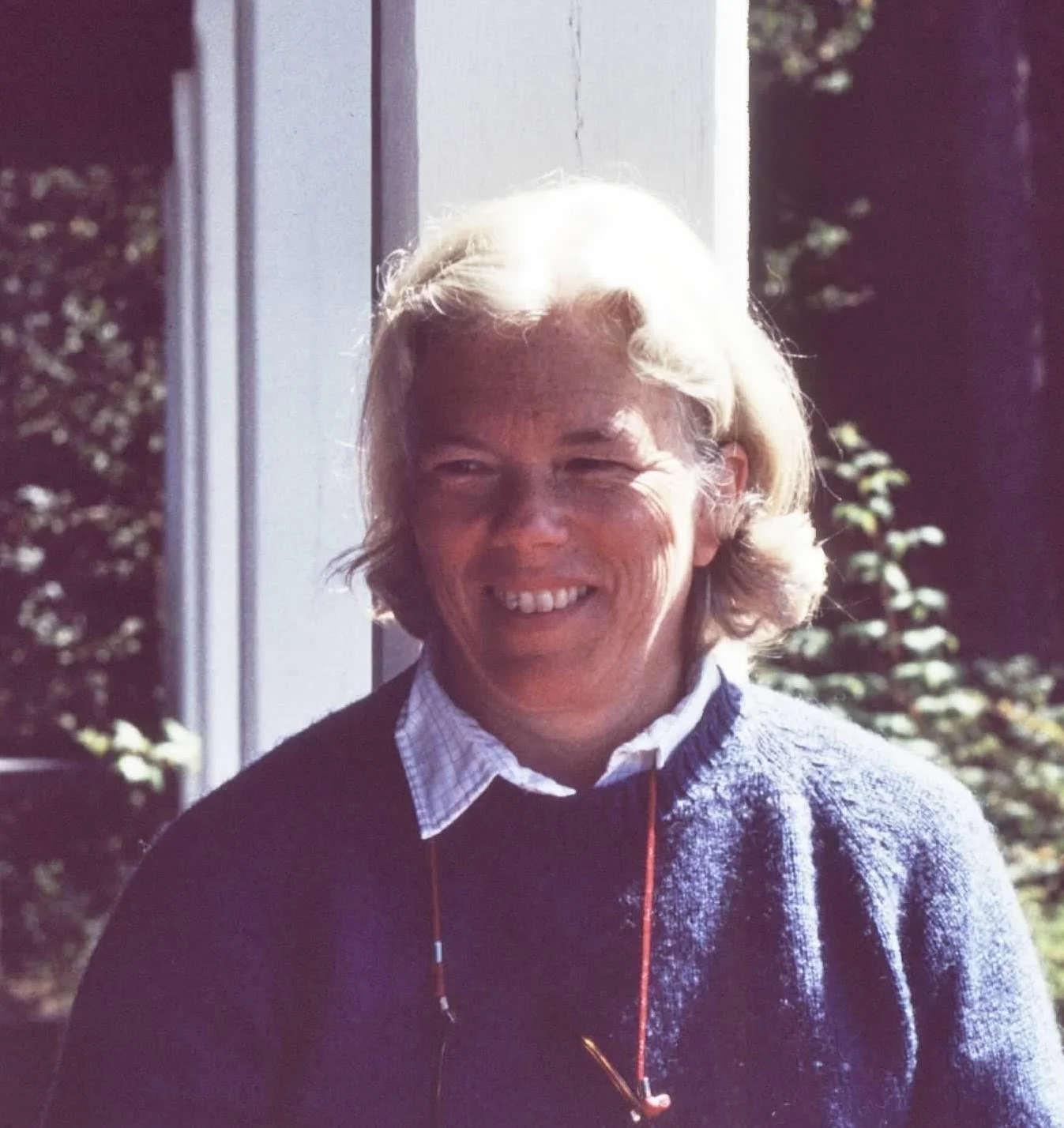
Laura W. R. Appell
In Memoriam
Laura W. R. Appell
February 20, 1932 - October 2, 2015
Laura W.R. Appell, Fellow of the Borneo Research Council, died unexpectedly on October 2, 2015 at the age of 83. Laura is buried in Phillips, Maine, in a cemetery on family land.
Laura W. Reynolds, daughter of distinguished Boston physician, George P. Reynolds, graduated from McGill in 1956, with a major in Geology and Geography. In 1956 Laura became administrative assistant and secretary to Professor J. O. Brew, Director of the Peabody Museum, Harvard, where her grandfather, Edward Reynolds M.D., had been director in the late 1920s. There she met George N. Appell, a graduate student in anthropology. They were married May 25, 1957 and immediately left for a canoe exploration of the Mackenzie River Basin in the Northwest Territories of Canada to find a site for fieldwork. Laura, whose passion for the outdoors, nature, and adventure were matched by that of her husband, spent that summer with the Dogrib Indians of Fort Rae, where at times she was left alone in the village while George was on hunting expeditions.
That summer of 1957 was integral in the creation of a dedicated husband and wife research team that spanned Laura’s professional life until her death. It was in 1958 when George was appointed a Research Scholar in the Department of Sociology and Anthropology, the Australian National University, in Canberra, that Laura and George’s extensive research on the Rungus Momogon began.
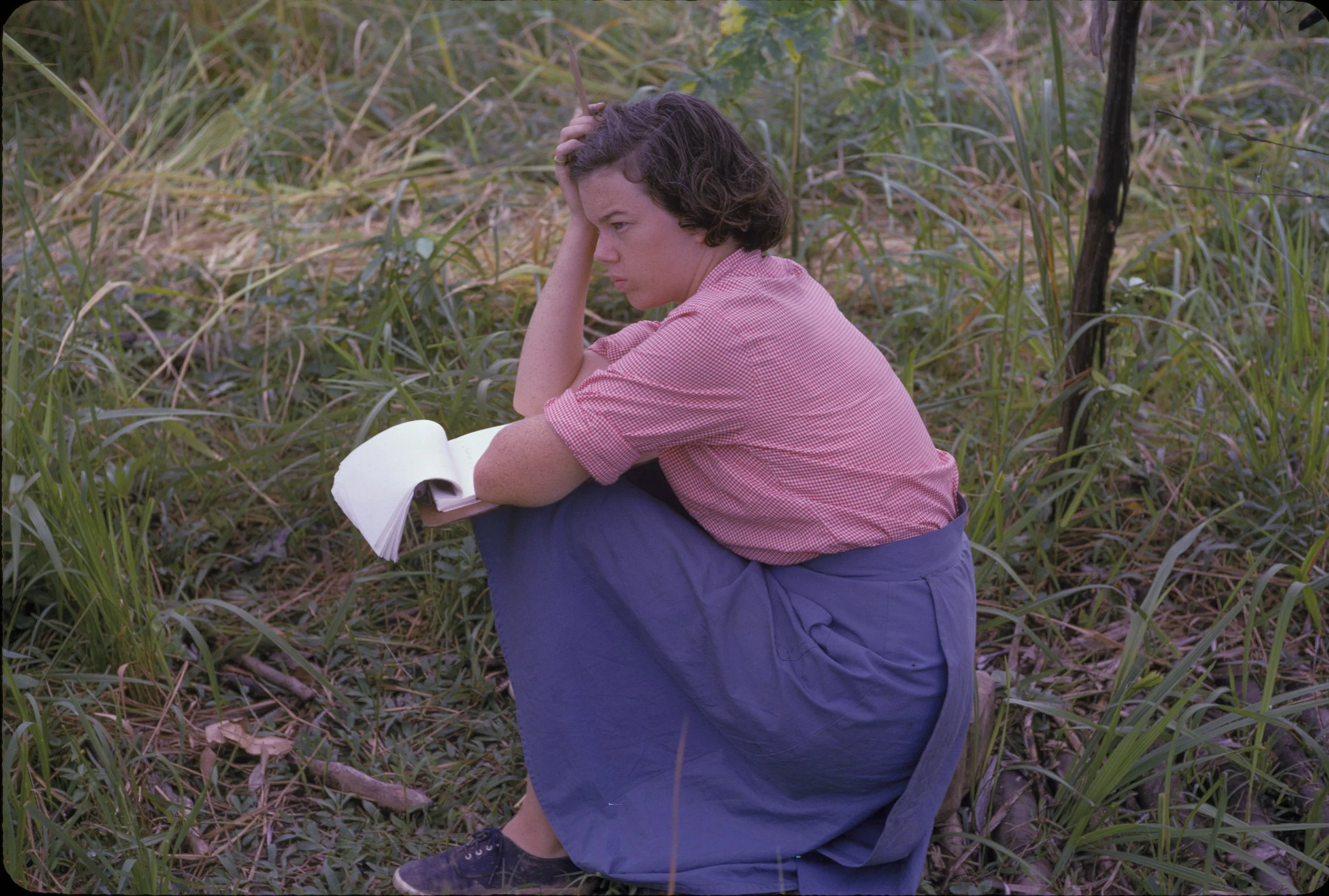
Their first child, Laura P. Appell (now Laura P. Appell-Warren, Ed.D.), was born while they were in Canberra, and in 1959 Laura and George took their 6-month-old daughter to live with the Rungus Momogun in the Colony of North Borneo. Their first field session ended in 1960 and a second field session took place in 1961-1963. From then on Laura and George spent at least part of every day, whether in the field or not, actively engaged in their research on the Rungus Momogon spiritual, domestic, and legal traditions. During that time in the field, in addition to raising young Laura, Laura learned the Rungus language and undertook research on kinship, religion, and women’s roles. This was critically important research as major aspects of health and fertility were largely in the hands of priestesses. Laura’s research led to the uncovering and study of the beautiful, chanted texts performed by priestesses at all the major ceremonies and which formed a large body of essential cultural data.
Their second daughter, Amity (now Amity A. Doolittle, Ph.D.) was born in Canberra in 1964 and their third daughter, Charity Reynolds Appell, was born in Maine in 1965. All three of their daughters experienced life in the field at various times and as a result have all become anthropologists.
Laura and George had planned to return to continue studying Rungus society on completion of George’s Ph.D. dissertation. However, following the withdrawal of the British from North Borneo, the government of Sabah, Malaysia, declared Laura and George persona non grata. In attempting to return to the Rungus in 1980 they and their three daughters were refused entry. George was sent back to Kuala Lumpur. But Laura and her daughters were allowed to stay overnight, permitting Laura to return to the Rungus for a few hours to visit Itulina her closest friend and priestess, who had been her source on the religion. Itulina who was then dying said she knew Laura would be coming back to see her before she died as she had seen it in a dream.
In 1980-81 Laura along with her husband and three daughters worked among the Bulusu’ of East Kalimantan, where Laura studied the Bulusu’ religion and kinship, and did additional research on the Punan.
It was not until 1986 when there was a change in the Sabah government that Laura and her husband were permitted to return to the Rungus. They found major social changes had occurred. But the exquisite oral literature of the Rungus religion remained in the knowledge reservoirs of the older generation. Therefore, following up on her previous work, she co-founded the Sabah Oral Literature Project with George to record and preserve this oral literature. This project is managed by the Rungus people themselves after being trained by Laura and George. The Sabah Oral Literature Project has produced a significant and extensive archive of historical accounts, epic narratives, myths and legends, agricultural ritual and prayers, and most importantly, the complex ritual poetry that was sung by priestesses at all major ceremonies for the various gods and spirits.
For a period, Laura and George returned to their field site every couple of years in the summer. They also hosted Rungus visitors several times at their home in Maine at which time they continued their training of Rungus on the collection of oral literature and enquired further into various aspects of Rungus culture.
In 1993 Laura and George founded the Anthropologists Fund for Urgent Anthropology Research. The contributions to this effort are used to fund the Royal Anthropological Institute’s Fellowships in Urgent Anthropology.
Laura was also cofounder in 1999 with George of the Firebird Foundation for Anthropological Research and served on the board. Together they developed the Fellowship program for the collection of the oral literature and traditional ecology of indigenous people. At the time of her death there were over 140 Fellowships awarded for research in all major continents.
Laura published both on her own and extensively with George on Rungus religion and culture, as well as on Bulusu’ religion. Laura’s most important theoretical publications dealt with menstruation and female roles in Rungus society. Laura pointed out in her ground-breaking article that menstruation is an unmarked category both socially and culturally. Laura suggested that the explanation for this is in a set of cultural values associated with what she termed gender symmetry. Rungus women occupy a position of high regard and share equivalent status with men. But there is also the basic value premise of Rungus society: sexual relations, if entered into illicitly, are dangerous and deleterious to the whole society. As a result sexual matters, particularly among unmarried females, are seldom discussed.
In Laura’s 1991 article she expanded on the concept of gender symmetry for describing male and female roles among the Rungus. She argued that aspects of ideology and behavior can be congruent or in conflict. Among the Rungus the ideology of equality and behavioral equality are identical in female and male roles and conflict between the sexes is minimal. She avoided the term egalitarian as it includes issues of social philosophy. Laura therefore used the term gender symmetry for those situations where the roles of both sexes are not identical but are given the same social valuation and are thus of equal importance for society functioning, being interlinked to form a whole.
At the time of her death, Laura was working together with George on the Rungus Cultural Dictionary, which includes extensive cultural descriptions. Laura had devoted her research life to the ethnography of Rungus society, and was never happier than when she and George returned to Rungus friends and village life.
Laura, in addition to her own contributions to the ethnography of Borneo, was a dedicated partner in all her husband’s activities and had a signal influence on his own research, life, and writings. The welcoming home she created, both in the field and in Maine, became a harbor for many wandering academics and their families. Conversations were always exciting and flowed easily. Laura at all times provided guidance and inspiration to those researchers going to Borneo and to those studying oral literature in Tibet and Bhutan (Please see the death announcement made by the Bhutan Oral Literature Project www.facebook.com/BOLPLDP/.
In 2014 the Laura W. R. Appell Fellowship was established by the Firebird Foundation to support the documentation of oral literature and traditional ecological knowledge that is based on the methodology that she helped develop in the Sabah Oral Literature Project.
In recognition of Laura’s commitment to the preservation of Borneo oral traditions and in recognition of her contributions to Borneo Ethnography, a fund to honor Laura W. R. Appell has been established by the Borneo Research Council to support the activities and publications of the Council.
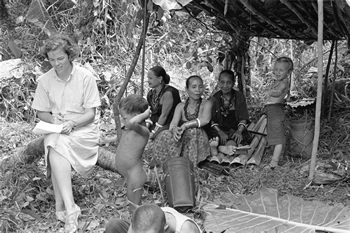
Laura W. R. Appell and young daughter Laura P. at a Rungus agricultural ceremony, 1962.
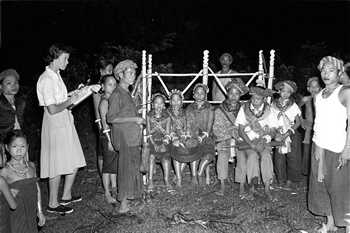
Laura observing a Rungus wedding, 1962.
In Memory of Laura
by Jacqueline Pugh-Kitingan, Ph.D.
Laura Appell, A Rungus At Heart
by Paul Porodong, Ph.D.
Bibliography
Appell, G. N., and Laura W. R. Appell
1961
A Provisional Field Dictionary of the Rungus Dusun Language of North Borneo. Duplicated. (Microfilm may be obtained from the Educational Resources Information Center, Clearinghouse for Linguistics.)
1993
To Converse with the Gods: Rungus Spirit Mediums. In The Seen and the Unseen: Shamanism, Mediumship and Possession in Borneo. Robert Winzeler, ed. Borneo Research Council Monograph Series Volume 2. Williamsburg: Borneo Research Council.
2003
Rungus Dusun. In Encyclopedia of Sex and Gender: Men and Women in the World’s Cultures. Carol R. Ember and Melvin Ember, eds. New Haven: Human Relations Area Files and Kluwer/Plenum.
2004
Death among the Rungus Momogun of Sabah, Malaysia: The Dissolution of Personhood and Dispersion of the Multiple Souls and Spiritual Counterparts. In Journeys of the Soul: Anthropological Studies of Death, Burial and Reburial Practices in Borneo. William D. Wilder, ed. Borneo Research Council.
2012a
The Collection of Oral Literature and Traditional Ecological Knowledge: A Field Guide. Phillips, ME: Firebird Foundation for Anthropological Research.
2012b
The Sabah Oral Literature Project: Theory and Methods. In The Collection of Oral Literature and Traditional Ecological Knowledge: A Field Guide. Phillips, ME: Firebird Foundation for Anthropological Research.
2012c
Nature and Function of Oral Literature. Phillips, ME: Firebird Foundation for Anthropological Research.
2013a
A Cultural Dictionary for Translation and Exegesis. Phillips, ME: Firebird Foundation for Anthropological Research.
2013b
Code Sheet for Recording Oral Literature. Phillips, ME: Firebird Foundation for Anthropological Research.
2013c
Code Sheet for Transcription and Translation. Phillips, ME: Firebird Foundation for Anthropological Research.
2013d
Rungus Classes of Oral Literature. Phillips, ME: Firebird Foundation for Anthropological Research.
2013e
Ethical Issues in Recording Oral Literature. Phillips, ME: Firebird Foundation for Anthropological Research.
2013f
Sabah Oral Literature Project. Phillips, ME: Firebird Foundation for Anthropological Research.
2013g
Rungus Vowel Phonemes. Phillips, ME: Firebird Foundation for Anthropological Research.
Appell, Laura W. R.
1958
With Paddle and Notebook in the Northwest Territories. Appalachia 24:37–44.
1988
Menstruation Among the Rungus: An Unmarked Category. In Blood Magic: New Perspectives in the Anthropology of Menstruation. Thomas Buckley and Alma Gottlieb, eds. Berkeley: University of California Press.
1991
Sex Role Symmetry Among the Rungus of Sabah. In Female and Male in Borneo: Contributions and Challenges to Gender Studies. Vinson H. Sutlive, Jr., ed. Borneo Research Council Monograph Series Volume One. Williamsburg: Borneo Research Council.
1998a
Memorials: Datuk Kitingan Sabanau. Borneo Research Bulletin 29:8–9.
1998b
Memorials: Florence May Langdon Ewins. Borneo Research Bulletin 29:8.
1998c
Memorials: Geoffrey Riddle Hedley. Borneo Research Bulletin 29:8.
Appell, Laura W. R. and G. N. Appell
1993
To Do Battle with the Spirits: Bulusu' Spirit Mediums. In The Seen and the Unseen: Shamanism, Mediumship and Possession in Borneo. Robert Winzeler, ed. Borneo Research Council Monograph Series Volume 2. Williamsburg: Borneo Research Council.
1997
Rungus Ritual Text from Sabah Oral Literature Project. Phillips, ME: Firebird Foundation for Anthropological Research.
2012
Community-Based Field Methods for the Collection of Oral Literature. Phillips, ME: Firebird Foundation for Anthropological Research.
2013a
Collection Suggestions. Sabah Oral Literature Series No. 3. Phillips, ME: Firebird Foundation for Anthropological Research.
2013b
Collection Issues and Suggestions. Phillips, ME: Firebird Foundation for Anthropological Research.
Unpublished Papers
Appell, Laura W. R.
1994
The Seizing of Indigenous Lands and the Destruction of Cultures by the Governments of East Kalimantan and Sabah, Malaysia. Paper delivered at the Borneo Research Council Session “Land, Law and Culture: Human Rights in Malaysia, Indonesia, and Brunei,” at the Annual Meetings of the American Anthropological Association, December 4, 1994.
Appell, Laura W. R. and G. N. Appell
1995
The Risks in Using Ethnicity for Mobilizing Political Action: The Failure to Transform Kadazan Ethnic Identity to Political Identity in Sabah, Malaysia. Presented at the Borneo Research Council Session “New Skins, New Wine: Substance and Symbolism of New Sociocultural Forms in Borneo,” at the Annual Meetings of the American Anthropological Association, November 19, 1995.